In What Way Bicarbonate Depletion Alters the Anion Gap
How to define the anion gap?
The anion gap is a derived value used to help interpret an acid-base imbalance and identify patterns of electrolytes in the blood. It compares the main measured positive and negative ions, especially sodium, chloride, and bicarbonate, to estimate the amount of unaccounted-for ions in the serum. This makes it a valuable tool for explaining metabolic acidosis and other forms of acid-base balance disturbance.
In clinical practice, the anion gap reflects an anion difference caused by unmeasured anions such as proteins, phosphates, lactate, and organic acids. Because sodium is the major measured cation and chloride plus bicarbonate are major measured anions, any change in these values can influence the calculation. That is why serum electrolytes are central to the interpretation.
Clinically, the anion gap is often used as a initial screening tool in laboratory assessment. It does not diagnose a condition by itself, but it helps guide the diagnostic approach. A normal or elevated gap can point toward different mechanisms of acidosis, and that distinction has major clinical relevance.
Although the classic formula may vary slightly by laboratory, the basic concept is the same: the measured positive charges are compared against the measured negative charges. Many clinicians now use an Anion Gap Calculator for quick calculation and to reduce arithmetic errors during interpretation.
What takes place when bicarbonate is lost?
Bicarbonate, also referred to as bicarbonate (HCO3-), is a key component of the body’s buffer system. It supports maintain acid-base balance by neutralizing excess acid. When bicarbonate is lost, the direct effect is a decline in serum bicarbonate, which can lead to metabolic acidosis.
From a physiology standpoint, bicarbonate loss represents a loss of base. The body may attempt compensation through the lungs and kidneys, but the underlying problem is often a true reduction in buffering capacity. Because bicarbonate is one of the major measured anions, its loss changes the relationship between sodium, chloride, and the remaining unmeasured ions.
In many bicarbonate-loss states, the body retains or generates more chloride to support electroneutrality. As bicarbonate falls, chloride rises, which is why a bicarbonate-loss pattern often produces hyperchloremic metabolic acidosis. This exchange can keep the total anion gap within the reference range even though the patient has clinically important acidosis.
The key point is that bicarbonate loss does not automatically mean the anion gap must rise. The anion gap may stay normal if chloride increases enough to offset the fall in bicarbonate. In other situations, bicarbonate loss can coexist with accumulation of hidden anions, producing a high gap instead.
Why bicarbonate depletion can cause a normal-gap acidosis
Metabolic acidosis with a normal anion gap is the classic pattern associated with isolated bicarbonate loss. Because bicarbonate is removed from the extracellular fluid, the body often trades that negative charge with chloride. The result is a fall in bicarbonate with a proportional elevation in chloride, leaving the anion gap near typical.
This type of acidosis is also called chloride-rich acidosis because chloride becomes relatively elevated. The bicarbonate drop is the key feature, but the chloride increase is what preserves the measured balance. In other words, the apparent normality of the anion gap does not mean the acid-base status is normal; it means the loss of bicarbonate has been matched by another measured anion.
Frequent diarrhea is a frequent cause of this pattern because the gastrointestinal tract can lose bicarbonate-rich fluid. RTA is another major cause, especially when the kidneys are unable to reclaim filtered bicarbonate or excrete acid appropriately. Both scenarios produce a recognizable pattern of metabolic acidosis with normal anion gap behavior.
In these cases, the body’s physiologic compensation may lower carbon dioxide on blood gas testing, but the core laboratory pattern remains driven by bicarbonate loss and chloride retention. Understanding this mechanism helps distinguish isolated bicarbonate loss from processes that add unmeasured acids.
How to read changes in the anion gap with loss of bicarbonate
Interpreting loss of bicarbonate requires going beyond a single number. The most practical approach pairs the anion gap with albumin, the corrected anion gap, base excess, and the rest of the laboratory values. This more complete view decreases the chance of missing a mixed disorder.
Albumin matters because it is a major unmeasured anion. Low albumin can decrease the measured anion gap and mask an elevated gap process. In a patient with hypoalbuminemia, a “normal” anion gap may actually mask a clinically important accumulation of acids. That is why the corrected anion gap is essential during interpretation.
Base excess from blood gas analysis gives another perspective on the severity of the acid-base disorder. A negative base excess supports a metabolic acid load or base deficit, while the serum bicarbonate level reflects the chemistry behind it. Taken together, these values improve interpretation and offer a more accurate picture of the patient’s status.
It is also helpful to consider the reference range used by the local lab because different methods and instruments may produce slightly different normal limits. A bicarbonate-loss state can look different depending on whether the lab calculates the anion gap with or without potassium, and whether albumin correction is applied.
How to use an Anion Gap Calculator to evaluate acid-base disorders
An Anion Gap Calculator is valuable because it transforms serum chemistry values into a quick, consistent calculation. It typically uses sodium, chloride, and bicarbonate from an electrolyte panel, and may additionally use potassium. This makes it easier to compare the anion gap against the expected range and detect patterns indicating an acid-base disorder.
When bicarbonate is low, the calculator aids distinguish whether the case fits a expected gap pattern or a high gap pattern. In practice, you enter serum electrolytes and then compare the result with the patient’s blood gas. If the serum bicarbonate is reduced but the anion gap remains in range, that indicates a bicarbonate-loss process such as diarrhea or renal tubular acidosis. If the gap is increased, consider an added acid load or mixed disorder.
Potassium may be included in some formulas, although its contribution is usually smaller than sodium, chloride, and bicarbonate. Even so, potassium abnormalities can support the overall clinical picture, especially when there is a significant electrolyte imbalance. The calculator does not replace clinical judgment, but it enhances the speed and accuracy of laboratory assessment.
For best results, use the calculator alongside the full diagnostic approach: review symptoms, assess volume status, inspect blood gas results, and look for evidence of compensation. The anion gap is most valuable when it is used as part of the whole picture rather than as an isolated result.
Frequent causes of bicarbonate depletion
Various disorders can result in bicarbonate wasting, and the source of the loss often decides whether the anion gap remains normal or shifts. One of the most frequent causes is gastrointestinal loss, especially from intestine-related fluid loss. In this setting, bicarbonate-rich intestinal fluid is lost straight away, causing metabolic acidosis with chloride preservation.
Kidney disease can also be a factor by impairing the kidneys’ ability to handle acid-base regulation. Some kidney disorders impair bicarbonate reabsorption or reduce acid excretion, leading to a persistent base deficit. In this setting, the chemistry may look like normal anion gap metabolic acidosis or, depending on severity and mixed processes, a more mixed pattern.
Proximal renal tubular acidosis is a distinct renal cause of bicarbonate loss. Here, the proximal tubule does not manage to reclaim filtered bicarbonate effectively, so bicarbonate is excreted in the urine. This is a classic cause of metabolic acidosis with a normal anion gap pattern, especially early in the course.
Carbonic anhydrase inhibitors can also produce bicarbonate loss by decreasing bicarbonate reclamation in the kidney. These medications may result in a predictable acid-base disturbance that resembles other forms of renal bicarbonate wasting. Recognizing the medication history is a key part of the diagnostic approach.
Across these causes, the underlying issue is the same: loss of bicarbonate reduces buffering capacity and disrupts acid-base balance. The anion gap delta delta for mixed disorder then reflects whether chloride replacement has offset that loss or whether hidden anions are also present.
When bicarbonate loss may coexist with a high anion gap
Loss of bicarbonate doesn't always produce a normal anion gap. It may happen alongside disorders that add extra unmeasured acids, leading to high anion gap metabolic acidosis. This happens when the bicarbonate fall is not simply matched by chloride rise because another process is increasing hidden anions.
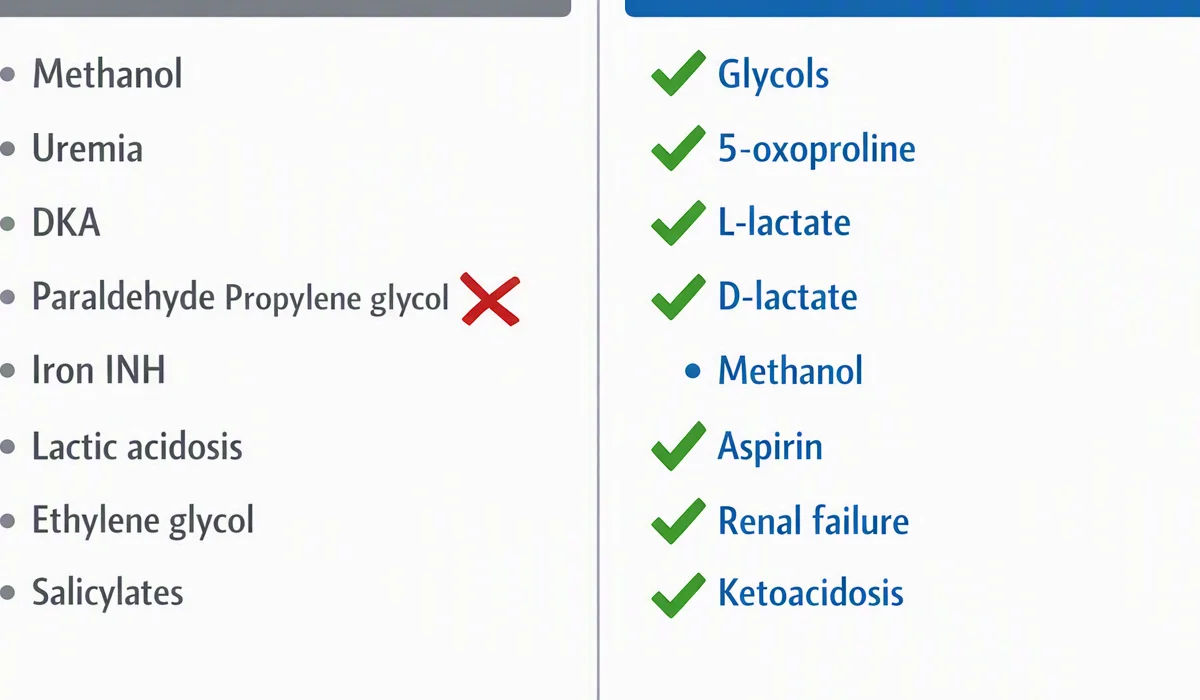
Lactic acidosis is one typical example. Lactate accumulation lowers bicarbonate and creates unmeasured anions, pushing the gap upward. Similarly, ketoacidosis leads to organic acid accumulation that consumes bicarbonate and increases the anion gap. In these cases, the bicarbonate loss is part of a broader acid-loading process rather than an isolated replacement phenomenon.
Uremia can also create a high gap state due to retained acids in advanced renal dysfunction. Even if bicarbonate loss is present, the accumulation of unmeasured toxins and organic acids may dominate the laboratory picture. This is why kidney-related acid-base disorders can be mixed and require careful interpretation.
Toxic alcohol ingestion is another important cause of elevated gap acidosis. Toxic metabolites contribute hidden anions, reducing bicarbonate and increasing the anion gap. If bicarbonate loss is present at the same time, the gap may be strikingly abnormal, and urgent evaluation is needed.
The clinical message is that bicarbonate loss can fall into either a normal-gap or high-gap pattern. Looking at serum bicarbonate alone is not enough. You need the full calculation, the blood gas, the corrected anion gap, and the context of the patient’s symptoms and exposures.
FAQ: bicarbonate loss and anion gap
How does bicarbonate loss change the anion gap?
Bicarbonate loss lowers serum bicarbonate and may affect the anion gap depending on what replaces that lost charge. If chloride rises to offset the loss, the anion gap can stay normal. If hidden anions also increase, the anion gap may become elevated.
Can loss of bicarbonate take place with a regular anion gap?
Absolutely. This describes the classic pattern in metabolic acidosis with a normal anion gap. The loss of bicarbonate is often matched by an increase in chloride, producing hyperchloremic metabolic acidosis rather than a high gap state.
Why does chloride increase when bicarbonate is lost?
Chloride increases to maintain electrical balance in the blood. When bicarbonate drops, the body often retains chloride as a replacement anion. This helps preserve acid-base balance on paper, even though the patient still has metabolic acidosis.
Does low bicarbonate always mean metabolic acidosis?
Low bicarbonate often indicates an acid-base disorder, but it does not always mean isolated metabolic acidosis by itself. A blood gas analysis is needed to verify the primary process and to see whether respiratory compensation or a mixed disorder is present.
When should an Anion Gap Calculator be used?
An Anion Gap Calculator should be used whenever bicarbonate is low, an electrolyte imbalance is suspected, or metabolic acidosis needs classification. It is especially helpful when reviewing serum electrolytes, comparing results with blood gas analysis, and deciding whether the pattern is normal gap or high gap.